Saturday, October 22, 2016

How Business Marketing Videos Can Be a Tremendous Business Booster?

Business folks often think of video-powered marketing as a tactic that is expensive as they believe it is luxury that only big names and brands can avail. They ignore the fact that investment in video marketing efforts is not as overwhelming as it sounds. It may even not require you to think of big budget. When it comes to engaging customers with your product, every attempt counts, and video can give you an opportunity to convert viewers more effectively than any other marketing endeavor.

Online video marketing is going explosive and certain real-time statistics will give you the idea of how marketing business videos can be an efficacious means of business promotion and product awareness. Mobile videos especially put massive psychological impact on customers covering the big chunk of their screen. Unlike text, videos spread the same message in matter of a few seconds.

Without further ado, let's understand how business marketing videos can prove to be a tremendous business booster online.

Videos directly increase sales and are a serious investment
  • 65% of U.S. marketers plan to increase their mobile ad budgets to account for video according to eMarketer.
  • 87% of online marketers use video content according to Outbrain.
  • 81% of senior marketing executives now use online video content in their marketing programs, up from 70 percent in 2011. (MarketingProfs)
  • These statistics and number suggest that business videos are no longer a trend or a luxury on any business website. Ecommerce companies are more and more driven to make business explainer videos that not only market their products but also educate visitors on how to wear and add style to their lifestyle.

    Because not every video has power to connect with audience and influence their purchase decisions, it is appropriate to contact a professional business video expert company as they have mastered making expressive videos that can establish lasting impression on customers' mind.

    Business Marketing Videos

    Video is a versatile marketing tool

    According to Forbes, 59% of executives would rather watch video than read text.

    46% of users take some sort of action after viewing a video ad, according to Online Publishers Association.

    According to a report published by Forrester, including video in an email leads to a whopping 200-300% increase in click-through rate.

    From the increasing the clarity on products, boosting public interest to persuading visitors to buy the products and winning their long time loyalty, there is little that video can't do. A good video script with meaningful explanation can lead casual visitors to getting converted in minimal time. Such business explainer video can be the driver of customer loyalty and high conversion rate. Looking at these tremendous benefits, for any business – either small or medium scale – can believe that business videos are indeed a versatile marketing tool.

    Videos benefit small business in gaining trust and spreading quick awareness

    22% of small businesses in US are planning to post a video in next 12 months, says Hub spot.

    According to a report published by Forrester, including video in an email leads to a whopping 200-300% increase in click-through rate.

    More than 60 percent of consumers will spend at least two minutes watching a video that educates them about a product they plan to purchase. (MarketingCharts.com)

    Video evoke a specific expression on viewer's face through the elements that connect deeply with human sentiments. Business videos are a great way to tell a story and move consumers to laugh, be curious, learns lessons, cry or feel inspired to do a decisive action such as purchasing. It helps gain trust and spread awareness in a way audio and text can't.

    A marketing video is a conversion generating machine

    Business Marketing Videos

    According to Video Rascal's recent survey, 85% of people are more inclined to buy from the business showcasing their ad with the help of handy explainer business videos.

    Unbounce reports that including video on a landing page can increase conversion by 80%.

    After watching a video, 64% of users are more likely to buy a product online, according to ComScore.

    Explainer business videos help budding business owners keep tally of how many visitors on their sites could become actual customers. Although most businesses manually count sales to see what products are most popular, explainer videos keep track of what product or service potential customers are interested by displaying the number of views on each video.

    It gives you a significant boost in your web traffic

    When video becomes famous among a community of people with common interest, the phenomenon is called 'going viral'. This is the gift from YouTube. A viral video gets a lot of attention and viewing in no time. Though there is no confirmed formula for this, several products have become popular through viral videos such as Apple iOS 5, Google currents, Dove, Old Spice, to name a few.


    Source: How Business Marketing Videos Can Be a Tremendous Business Booster?

    Friday, October 21, 2016

    Build new web and mobile solutions for your customers with Microsoft PowerApps and Microsoft Flow

    To complement the upcoming launch of Dynamics 365, including PowerApps and Flow, we are happy to announce a free Partner Roadshow with instructors from the PowerApps and Flow product team.  Please use the attached Partner Invitation to share with your Partner community!

    Dates and Locations:

    Chevy Chase, MD

     December 5, 2016

    Boston, MA

     December 7, 2016

    Irvine, CA

     December 7, 2016

    San Francisco, CA

     December 8, 2016

    Bellevue, WA

     December 9, 2016

    New York, NY

     December 9, 2016

    Minneapolis, MN

     January 16, 2016

    Dallas, TX

     January 17, 2017

    Chicago, IL

     January 18, 2017

    Registration:https://www.microsoftevents.com/profile/web/index.cfm?PKwebID=0x245842e630

    Training Topics:

  • Overview of Microsoft PowerApps & Microsoft Flow
  • SharePoint Online Integration
  • Common Data Model
  • Hands-on Exercises
  • Product Roadmap
  • Partner Solutions and Business Opportunities
  • Question and Answer Session
  • Audience:

    Technical consultants, application consultants, presales and similar roles. Also open to marketing and sales roles.


    Source: Build new web and mobile solutions for your customers with Microsoft PowerApps and Microsoft Flow

    Thursday, October 20, 2016

    China's Internet Stars Embrace Lowbrow รข€” And Aim For High Profits

    Huang Xian'er came of age while watching Internet celebrities' streaming videos on her smartphone in western China's Yinchuan city.

    "My mom knew I was watching Internet stars in school," she recalls. "She simplistically thought that all Internet stars sell clothes, get plastic surgery and all look the same."

    The stereotypical Chinese Internet star's cookie-cutter facial features — for men and women — include doe eyes, a high nose bridge and a pointy chin. Huang shares all these, and although she retouches her photos a bit to accent her features, neither she nor her mother sees any need for surgery.

    Huang aspires to fame in China's streaming Internet video market, which Credit Suisse estimates will be worth $5 billion next year, not far behind the country's $7 billion in movie box office revenues.

    Just a few months out of college and after only a few months of work, Huang, 20, already has a few hundred fans on her channel on Youku, China's version of YouTube. And she has signed a contract with an Internet talent firm.

    Internet stars will change the structure of China's society and economy, says Beijing University new media expert Tian Li, and will increasingly vie with traditional media and political elites for attention and authority.

    "To a certain extent," she predicts, "they will change the answer to the question: Who is most influential in our society?"

    Such complexities are far from Huang's mind as she tries to carve out a niche for herself as a specialist in travel videos.

    On a recent day, Huang sits down in the studio of the talent firm that's signed her to live-stream a video, chatting with a guest about hiking around Beijing.

    As they talk, little emoticons — hearts, flowers, gifts — waft across the phone's screen. Huang's fans spend real money to buy these virtual gifts and she gets a cut of it.

    Next, Huang shoots a video that parodies state television's evening news. It also contains commercials for various Chinese delicacies, from hairy crabs to smelly tofu to fresh coconuts.

    It's a tongue-in-cheek mashup of advertorial and infotainment. The other ads are fake, but the crab ads are real. Huang and the talent firm's boss, Gu Yongliang, cut a deal with a food company to mention the product in their video.

    Because Huang is not famous and has relatively few fans, Gu's company didn't charge the food firm to plug the crabs. They did it just to build their network and get experience.

    Gu, Huang's 35-year-old boss, is positioning himself at the bottom of the industry. He's cultivating potential stars with no fan bases. Companies up the food chain with more money to invest will sign only established stars with up to a million fans.

    Gu learned Internet marketing in his former job with the travel website TripAdvisor. He started his Internet video firm in March. He's now "incubating" more than 40 Internet stars, who live in a communal dormitory and live-stream hours of Internet video each day.

    In some respects, Gu's enterprise looks familiar to journalists and artists. He's producing Internet content, trying to make it go viral and then monetize it. Gu hasn't turned a profit yet, but he likes what he's doing.

    "To help these young Chinese with dreams to go even further in their creative work is something I feel that has great value," he says.

    His strategy is to market Huang as a travel video specialist because it's a relatively uncontested niche in China.

    Comedy, for example, is dominated by Jiang Yilei, a Shanghainese drama school grad student whose rapid-fire caricatures border on social criticism. Her videos have won her millions of fans and millions of dollars in advertising fees.

    Zhang Dayi, who sells clothes that she designs on her online store, typifies another, more commercial type of Chinese Internet star.

    There are also legions of mostly female stars who host live-streaming shows in which they sing, dance, bump, grind and banter with an audience that is mostly young, male and from second- and third-tier cities, and who shower the stars with virtual gifts.

    The government has warned against programming it considers vulgar and hedonistic, and Internet stars are ignored by the country's mainstream media.

    But Beijing University's Tian Li argues that fans are not looking for professionally produced, highbrow content. They want content they can relate to, made by people they idolize.

    "Because I like you or your image, I don't really care what you're saying," she explains. "What's more, just because I'm your fan, I'll gladly accept anything you recommend."

    Tian adds that government efforts to regulate the live-streaming industry are unlikely because they would be too difficult to enforce. And she insists that Internet stars should not be easily dismissed.

    "We should give them more opportunities for healthy growth, and not make the whole industry feel that they're inferior," she says. Or make them feel, she adds, that they can only "get rich in silence" without ever earning society's acceptance.


    Source: China's Internet Stars Embrace Lowbrow — And Aim For High Profits

    Wednesday, October 19, 2016

    Tips for Marketing Your E-Commerce Biz

    :: By Derek Miller, CopyPress ::

    The e-commerce economy is thriving. Every day more and more online businesses are launched, with competition only getting more difficult.

    While starting an e-commerce store is easy, to really dominate an industry, you need to invest resources to growing the brand through digital marketing initiatives. Whether you recently launched an e-commerce store or have been running your online business for several years, the # digital marketing tips below can help you gain a competitive advantage in your niche. 

    Nail the Branding

    Hopefully, you've spent time strategically thinking about your e-commerce business brand. If you haven't, then this is the first place to start. Some of the most important elements of e-commerce branding include:

    The Name

    Your brand's name is a crucial part of your branding efforts. Not only should you make your brand name unique and memorable, but it should relate to your identity. The name is the first thing a new customer will notice and you need a good one in order to make a strong first impression. Take your time picking out a strong brand name that matches your e-commerce product. Also, check domain availability and try to find a brand name that has an exact match domain available. 

    The Logo

    Much like the name, a good logo can go a long way in improving your e-commerce brand. The logo is another element of your brand that should communicate your identity to customers, while also imprinting itself in the memory of those who see it. To create a great logo, you should focus on the design and the color. For example, brands that want to evoke excitement, energy and vibrance, should consider making their logo red. 

    The Tagline

    A tagline/slogan is another important part of branding efforts. An effective tagline needs to be short, usually around five words, and convincing. Try to convey your strongest benefit to the customer as quickly as possible. A strong tagline can quickly communicate to an audience why they should consider a brand. If you're struggling to come up with a strong tagline, you can try a free slogan maker to get the creative juices going. 

    Leverage Your Biggest Asset

    Once you've nailed your branding, the next step in marketing your ecommerce business, is to design your website. Your website is your single, most important marketing tool as an e-commerce business. You are directing all of your offsite marketing efforts to drive people to your website, so it needs to be a good representation of your brand. 

    When working on your e-commerce Web design remember to:

    Optimize your website

    In 2016, it's important that your site be optimized for all devices, mobile, tablet and desktop. Not only that, you should try to minimize your site to remove excess files and increase page speed. Making sure you nail the technical optimization will help provide a crisp user experience that customers have come to expect from e-commerce businesses. 

    Highlight your branding

    If you've spent all the time and resources nailing the branding, don't neglect those elements on your website. Make your logo and tagline prevalent on every page. Use your colors throughout the design in a clean and consistent manner. Driving home your brand identity through strong web design is a critical marketing component for your e-commerce brand. 

    Emphasize conversion points

    Your website is the strongest marketing asset that you have as a brand. You can build followers on Twitter, Instagram, Facebook, etc., but you're always limited to the constraints that the particular platform places on you. However, you have complete control of your website and can say or do anything that you please. Thus, you should not be afraid to emphasize conversion points on your site. A conversion point is a way for you to perpetuate an action from the user on your website. This action could be purchasing a product, completing a survey, following your brand or giving you their email. Make sure you have a conversion strategy and don't be afraid to leverage your most versatile marketing asset. 

    Make the content unique

    When it comes to marketing on your website, the content must not be neglected. Too often, e-commerce businesses invest resources into everything else on the website, except the content. They simply insert boilerplate content on their web pages, use manufacturer's product descriptions, or don't have any content at all. Outside of the SEO benefits to onsite content, it's also a critical component in convincing users to purchase from you. Writing unique, compelling copy and publishing regular content will help you tremendously improve your digital marketing results. 

    Use offsite marketing channels 

    Even though a website is the most important digital marketing tool for growing your e-commerce brand, offsite marketing channels like email, social media and other sites are also important and should not be forgotten. Taking time to leverage offsite marketing channels will help generate more inbound traffic and sales. 

    Some easy tips for using these offsite channels are to:

    Be consistent, not annoying with email marketing 

    Email marketing is an effective marketing channel that allows you to get a customized, marketing message in front of your leads. It's important that you send emails regularly, especially to the users that show activity on previous emails. However, you need to stay on top of your email marketing data. If users are not opening your emails or taking no action after the open, then you should adjust your marketing message. 

    Leverage social media

    Social media is another offsite marketing tool that e-commerce businesses must use to drive traffic to their sales pages. Social media provides a platform for building followers and fans to communicate directly with your brand. It's important to remember that social media isn't just a one-way communication channel. You should create real relationships with your followers and provide them value that extends further than just the e-commerce products you are trying to sell. Curate and share content from peripheral brands, create engaging discussions and polls and reply to people that communicate with your brand. 

    Be active on other publishers

    Someone wise once said, "to succeed at marketing, you should go where your customers are." That concept is especially true for marketing a new e-commerce business. Your brand has a finite reach with your website and social followers. However, you can quickly amplify your reach by leveraging other publishers. Find publishers that are relevant to your brand and be active on their site. Comment on their articles, communicate with the publisher on social media, or reach out and try to guest post on their site. By being active on the other publisher, you'll be able to get your brand in front of the eyes of people that follow that publisher and drive more qualified traffic to your site. 

    The e-commerce economy is one of the most thriving places for new entrepreneurs. If you're looking for ways to market your ecommerce business, consider the tips above. 

    Derek Miller is a content marketing consultant for CopyPress, which is a leading digital content production company, specializing in articles, infographics, interactives and videos. Check out CopyPress' latest white paper on, "Exploring Different Types of Multimedia."

     Request Website Magazine's Free Weekly Newsletters 
    Source: Tips for Marketing Your E-Commerce Biz

    Tuesday, October 18, 2016

    Here's How My E-newsletter Remains My Best Marketing Tool

    If you ask me what my number one marketing tool is, my answer might surprise you. It is my electronic newsletter. Yes, that thing that most entrepreneurs abandoned years ago.

    Some people believe it's too time consuming to write, that it just ends up in spam folders, and no one reads it. And for some, this may be true. Recently, I read in Smartblogger.com that newsletter publishers are "now the sad old fuddy-duddies of the online marketing world, hopelessly outdated, clinging desperately to a dying technology, destined to be crushed by new and savvier competitors." But I disagree. I have earned thousands of dollars over the years sharing my tips, tools and advice with others.

    I started writing my newsletter, The Protocol Post, in 2001 when paper, mail-away newsletters fell by the wayside. Email became the quickest way to communicate and e-newsletters became extremely popular. As the years went on, most people stopped sending newsletters and started a blog. A couple of years later, social media became the preferred method of marketing and communication and newsletters become almost extinct.

    Don't get me wrong. I do all of the above, but I am "old school" therefore I keep my newsletter going for a variety of reasons:

    It's affordable.

    Although there are many popular email marketing services out there including MailChimp, iContact and others, I choose to use Constant Contact. I pay a modest monthly fee that is calculated on the amount of subscribers I have. When I do the math, I know I receive a return on my investment if at least one or two subscribers decide to purchase one of my products or books a seminar or speaking engagement.

    It keeps me in touch.

    I try my best to send out a newsletter at least once a month. Any more than that and I might be labeled a pest. Less than that and it's probably not worth my while to pay for the service.

    I share personal stories.

    I receive numerous emails from people who love to read about me, including my accomplishments and trials and tribulations. When I started writing my newsletter years ago, I kept it all business related. Then I decided to open up a bit and everything changed. I started receiving more subscribers. Each month, I personalize the greeting in every newsletter and share what was going on in my life. Over the years, I have talked about subjects that most people are apprehensive to discuss including my mother's death, my divorce, my move into a boathouse, and the passing of my beloved four-legged companion, Oliver. When you connect from the heart it makes you more relatable and human. That adds up to dollars and good sense. My stories keep people coming back and interested in reading what I have to say each month.

    Related: 101 Businesses You Can Start With Less Than $100

    I announce my latest products, classes and services.

    I never inundate my readers with a lot of ads. That's the quickest way to lose followers. Instead, I prefer to I send out a special announcement or class schedule if I have a seminar or promotion coming up. This way, I can cover more important topics in my monthly e-newsletter.

    It builds credibility.

    A newsletter is as the perfect place to post articles, podcasts and TV appearances. By doing this, I direct readers to my YouTube page, my website, and my Entrepreneur.com author page.

    It can be recycled.

    After each newsletter is published, I share it on my social networks, including Twitter, LinkedIn and Facebook. This ultimately gets my face in front of even more potential clients.

    It keeps me top of mind.

    Someone once said, "Out of sight is out of mind." That's definitely the case when it comes to marketing. If your clients see or read about your competitors but they don't see or read about you, they are going to forget you and hire someone else. My newsletter keeps my name, face and tips in front of more than 5,500 dedicated subscribers. For me, email marketing is the key to building and maintaining relationships. It could be said that "your list is your lifeline." When people think of etiquette, my hope is that they are going to think of me first and foremost.

    Unfortunately not everyone understands how to use email marketing in the most effective way. In fact, you could be making common mistakes that actually cost you customers rather than enhance your relationships with them.

    Here are a few tips for best practices when it comes to email marketing.

    Related: How to Make Your Instagram Account Impressive

    Only send to those who subscribe.

    It's best to grow your list organically through personal contacts or interesting content, like a free report or first chapter of your book. Put a link on your website encouraging people to sign up. You won't get the best results if you purchase a list or send your email to those who do not subscribe on their own.

    Weed out your list occasionally.

    Give people a way to opt out if they no long want to receive your emails. Take them off your list as soon as they ask, and respond quickly to any correspondence.

    Make it easy to subscribe or unsubscribe.

    People will get irritated and lose interest if they have to go through a multi-stage process to unsubscribe or complete a transaction, or uncheck a list of subscription boxes. One click of a button should direct subscribers to where they want to go, with clear and polite instructions.

    Don't overwhelm them. 

    One way to get blacklisted is to send emails far too frequently, especially every day of the week. Send emails on a scheduled basis so people anticipate their regular arrival, or send them only when you have something substantial to say.

    Try not to put too much information or include too many pictures or images that take too long to load. Consider that people scan their emails and read quickly, write to the point and put your most important information up front. Take the time to craft a well-written, cleanly-formatted message and run it through spell-check at the very least. Don't copy and paste text from other sites or plagiarize text. If you're not a writer, hire a professional copywriter.

    Related: 10 Ways to Develop an Unshakable Belief in Yourself

    Customize your subject line.

    Communicate clearly and offer a subject line that hints at what is to come. Compel people to read further. Stay away from exclamations like "Read This!" or "Exciting News!"

    The best newsletters are genuine, sincere and contain valuable, useful or worthwhile content. Email marketing is still the most viable, affordable way to get your point across. Once you build trust and develop your relationships with your readers, you will have to work less to keep your customers and clients forever.


    Source: Here's How My E-newsletter Remains My Best Marketing Tool

    Monday, October 17, 2016

    How Emotion-Detection Technology Will Change Marketing

    Imagine someone arrives at your website, Facebook Page, or advertisement. Now, imagine that you could change your marketing dynamically, right there on the spot, in response to their emotional reactions.

    It would be nothing short of a game changer for your business, right?

    Yet this is not fantasy. Exploding with investment and technological advances, the world of emotion detection and recognition technology will change the face of marketing in the years to come.

    Emotions are what drive your audience to purchase. In fact, studies by the neuroscientist Antonio Damasio found that people with damage to the part of the brain that triggers emotions -- in other words, people that are unable to feel emotions -- find it extremely difficult to make decisions.

    The lesson? If your marketing is not evoking an emotional response from your target audience, you are making it extremely difficult for your prospective customers to purchase from you. That's right, your own marketing is potentially causing prospects to turn away from you and your brand.

    What's a marketer to do? Let's dive into some research. 

    The Power of Emotions

    Many of the most successful marketing campaigns and initiatives are focused on emotions. Take Dove's "Real Beauty" campaign, which was an attempt to change the conversation around women's beauty. Or Nike's "Just Do It" campaign, firing up the inner-athlete in everyone. Or MasterCard's "Priceless" campaign, which has been powering brand success for a whopping 19+ years.

    All of this marketing aims to move your heart, and then relies on the experience to build a lasting bond with the brand. What it doesn't do is rely on feature sets, discounts, or new technology to move you to a sale. None of it speaks to the number of offices, employees, or years in business of the brand. Google Senior VP of Global Marketing, Lorraine Twohill, states, "If we don't make you cry, we fail. It's about emotion."

    Twohill is not alone with this sentiment. Multiple studies point to emotional marketing as more effective than other forms of marketing (e.g., product-focused marketing). Based on an analysis of 1,400 successful ad campaigns, the book Brand Immortality by Hamish Pringle and Peter Field reveals that advertising campaigns focused on emotional content performed approximately twice as well (31% vs. 16%) as those with only rational content.

    The power of emotional content should not come as a surprise. After all, emotions drive us to action. As consumers, we first decide on a purchase based on emotion, and then try to justify it through the more rational parts of our brain. Longer-term, emotions are what cause people to prefer brand names, even if generic alternatives are available.

    Findings from a 2015 Nielsen Consumer Neuroscience study of 100 ads across 25 brands in the consumer goods market revealed that ads with the best emotional response generated a 23% lift in sales, meaning that emotional marketing is not merely effective as an engagement vehicle but also as a true business driver.

    And don't think that emotion-based marketing is applicable to only B2C marketing and individual consumers. Business buyers are also creatures of emotion. In fact, successful B2B companies like GE, Cisco, IBM, AutoDesk, and Qualcomm all focus on emotions in their marketing. Similar to the Pringle and Field findings, the research report "From Promotion to Emotion: Connecting B2B Customers to Brands" by CES and Google explains that B2B brands achieve roughly twice the impact with a target audience when appealing to the personal value to the buyer including emotional benefits. 

    A Mountain of Investment

    In consideration of the power of emotional marketing, it should be no surprise that the emotion detection and recognition market is projected to be worth $22.65 Billion by 2020, according to the market research firm MarketsandMarkets. As a result, investment in the space is exploding.

    Apple, one of the most valuable companies on the planet, has been keenly interested in emotion recognition for years. In 2014 the company filed a patent that described software for analyzing and identifying a person's mood based on a variety of signals, including facial expression. Earlier this year, Apple acquired Emotient, an emotion-recognition technology company.

    Emotient has a patent for a method of collecting and labeling up to 100,000 facial images a day, supporting a computer's ability to recognize facial expressions. It's reasonable to believe that Emotient's emotion recognition technology will start appearing in iPhones and iPads before you know it, and then possibly used as a platform for more targeted and dynamic engagement when users are in their browsers.

    Last year the consumer-research company Nielsen bought Innerscope, which uses biometrics such as brain scans and galvanic skin response (GSR) to measure subconscious emotional responses to media and marketing.

    Affectiva, an emotion recognition technology developer, raised $14 million just a few months ago. Affectiva boasts the world's largest emotion data repository, with 40 billion data points and close to 4 million faces analyzed using its technology.

    Overall, those using emotion analysis to test audience reaction to their marketing include major marketers such as Unilever, P&G, Mars, Honda, Kellogg, and Coca Cola. For example, Kellogg's used Affectiva's software to determine its ads for Crunchy Nut cereal, with the goal of generating high engagement rates with the audience. Viewers were shown multiple versions of a commercial featuring animals. A version of the ad featuring a snake produced the most laughs, but low engagement rates when viewing the ad a second time.

    The facial recognition software revealed that an alternative version of the ad featuring an alien produced the desired engagement levels. Kellogg's therefore decided to rollout the alien-based ad instead, helping to drive the cereal's sales.

    Nothing Short of a Revolution

    Being able to adjust one's marketing dynamically, based on the real-time reactions of your audience, will empower marketers to provide the right message at the right time to the right person.

    In the future, it's likely that you'll be able to calibrate your marketing mid-stream with just about any digital experience -- no two prospects may experience a brand's marketing in the same exact way.

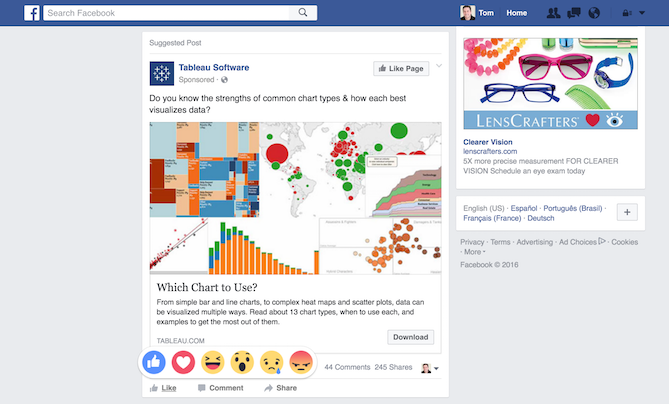
    Going beyond advertising, you can already see how Facebook is on a path to incorporating emotional reaction into a user's News Feed by introducing "Reactions" this past February. Rather than simply "Liking" a post, users can now designate their reaction across six emotions: Like, Love, Haha, Wow, Sad, and Angry.
    facebook-reactions-669x404.png

    Facebook interprets the use of Reactions as an indication that a person's network on the social platform wants to see more of those types of posts. That type of primitive application is sure to evolve moving forward. Sammi Krug, Product Manager at Facebook, explains, "Over time we hope to learn how the different Reactions should be weighted differently by News Feed to do a better job of showing everyone the stories they most want to see."

    As of the time of this writing, Facebook Ads treat Reactions the same as Likes. Ad reports do not include a breakdown of individual Reactions, although the breakdown can be found in Page Insights. For ad delivery, as well, Reactions are treated the same as Likes. Of course the next logical step will be for Facebook to treat different emotional reactions differently, rewarding Love more than Like, for example, and demoting an ad's visibility if users express anger.

    The Future

    It's safe to say that we should expect a great deal of change in the world of marketing moving forward. Gabi Zijderveld, CMO at Affectiva, provides a peek into the future by explaining the evolution of emotion recognition technology:

    Initially, the technology was used to understand how consumers engage with their brand content and advertising, and how these emotions then influence brand awareness and purchase intent. Now the technology is also used to infuse consumer experiences, apps and interactive advertising with Emotion AI. This will help to transform the face of marketing and advertising by reading human emotions and then adapting consumer experiences to these emotions in real time. The technology gives marketers the power to truly delight and engage their customers with uniquely dynamic and personalized interactions."

    Web development is already on the path towards more personalization. As emotion recognition technology becomes more sophisticated and more deeply embedded in our array of devices, it will become expected that our computers and phones provide us with a continual progression of customized triggers and messaging. The technology will be found even in future car dashboards, refrigerator doors, and conference room walls -- essentially any surface will become a possible means for detection of emotions.

    Social media will constantly focus on each user's emotions. For example, in the future expect Facebook's algorithm to focus just as much on one's emotional reactions as it does to one's historical click behavior, providing a unique social environment that goes far beyond prediction of the types of posts, pages, and ads one would like. Expect Facebook Ads to provide advertisers with the ability to hyper target not only based on age, geography, and job titles, but also on the individual's emotional state or progression of emotional states.

    Online marketing will likely evolve into sequential experiences, with deeper engagement upon recognition of positive emotional reactions. You can also expect more deeply embedded forms of marketing similar to product placement. Ultimately, expect emotion recognition to be just another core component of marketing, similar to how "digital marketing" is now really just "marketing."

    Emotion recognition technology is clearly bringing about a revolution in marketing. Are you ready to start capitalizing on the opportunity?

    Subscribe to HubSpot's testing Get the latest articles straight to your inbox.Enter your email address below:
    Source: How Emotion-Detection Technology Will Change Marketing

    Sunday, October 16, 2016

    Marketing for Dummies

    Hey, thanks for following. Now follow this blog if you want to learn affiliate marketing, it is written so the beginner and those who know nothing; Marketing for Dummies. Know coming in, this is not a get rich quick scheme, and no matter what you heard or read, if you are not committed for the long hall you are probably going to come up short in reaching success.  Affiliate can be defined as to receive into close connection or association (with a larger body, group, organization, etc.); adopt as a member, branch, etc..  Marketing can define as the total of activities involved in the transfer of goods from the producer or seller to the consumer or buyer, including advertising, shipping, storing, and selling. Affiliate marketing allows one to promote any products or services that has an affiliate program and collect commissions from it. Your website is given a link to the affiliate program, and it tracks transactions from your site back to your affiliate program. Now let us combine the definitions of affiliate and marketing and learn how to become a successful affiliate marketer.affiliate marketing components When the product or service is purchased, you get the commission. Now that being said, you will now be given the tools on how to become an affiliate marketer, and eventually, quit your 9 to 5 wage day job, and let the income from affiliate marketing make your dreams come true, and that Marketing for Dummies label will never be in your vocabulary again.  Other affiliate marketers, including myself, understand that your first instinct is this a get rich quick scheme." This is not a technique that is about to go away anytime soon. Its future is as far-reaching as that of the internet itself.  When it is known that 9 out of 10 families have to work two jobs to make ends meet, which has become a necessity Wealthy Affiliate becomes a viable alternative for reinventing your life. Marketing for Dummies Your Strategy Set your Goals and Mission Statement Building a business carries significant responsibilities, correctly setting goals in increments will lead to the ultimate aim. You will gain a sense of personal and professional achievement with every accomplishment reached. Smaller achieved incremental goals will result in a product with quality. Writing your Mission Statement and placing it in a visible area where you see it constantly is beneficial in this process.

    set goals and focus on your priorities

    Attitude Can affect you personally and professionally. Professionally your frame of mind has to be focused on your passion for being successful. Personally, the way you feel and react to different circumstances throughout a day has a direct correlation to your health and obtaining any happiness.  Staying in control of your mind emotionally is an absolute must. Target audience Knowing what your target audience is a major factor for conversions, whatever your niche may be, your viewers want information first.How to Target an Audience Life cycle of a customer People often learn about different products/services offline before they migrate online to do research, and quite often, make a purchase online. Learning at how and when to engage your customer will lead to more conversions.Customers lifestyle Search engine optimizations(SEO) Can be used by combining PPC. (These are the ads you see on the right side of a search SEO optimizationengine page. One would bid to be positioned in the ranking order). And Organic search is the process of tweaking/optimizing a website or page or blog so it ranks well in search engines so it can be linked to keywords. This is the best and least expensive option for getting visitors because visitors click on the free organic listings more than paid listings. Connecting with your audience Captivating your audience is your mission being able to get your audience to read all the way through your article requires technique. Deliver content that keeps engages curious for more. Connect with Your Audience  Lead generation Lead generation is often seen as the dirty work of building a profitable business. Although it is hard work, it is the life ofGathering and generating leads your business and skill you need to learn. It's looking for customers, and you get those leads in different ways and with varying degrees of success. E-mail marketing Is a way to generate leads. Creating a newsletter and an email list (often done with autoresponders), is a way to go. But this something you want to stay ahead of and keep up to date. Managing your email Social Networking Is gaining traffic or attention through social media sites. Social media marketing usually centers on efforts to create content to encourages readers to share it on their social networks. Social media is the electronic word of mouth (eWoM). The communication consumers share via the Internet social networks about an event, product, service, brand or company.social icons When the communication from a user to user, presumably resonates because it appears to come from a trusted, third-party source, as opposed to the brand or business itself, this form of marketing results in earned media rather than paid media. Social networking websites allow individuals to interact with one another and build relationships. When companies join these social channels, consumers can interact with them directly. That interaction can be more personal to users than traditional methods of outbound marketing.mentoring A Good Mentor Mentors serve as an external advisor with whom one can discuss work-related and other concerns related to career development and planning. A mentor is usually, has at least two years of experience in his student.  To assure an adequate experience and maturity level. Update Since I published this article, there has been a change of course in marketing.  It is not just having a website when promoting; you must include mobile marketing as major part of your campaigns.  Thanks for stopping by,  I wish you all the best with your online business, and, may you be blessed and prosper. Let's communicate, share a comment or question, they are important. And I will get back in touch with you.                     Join my affiliate marketing team and turn your passion into a success with a home business now!


    Affiliate Disclosure


    Source: Marketing for Dummies